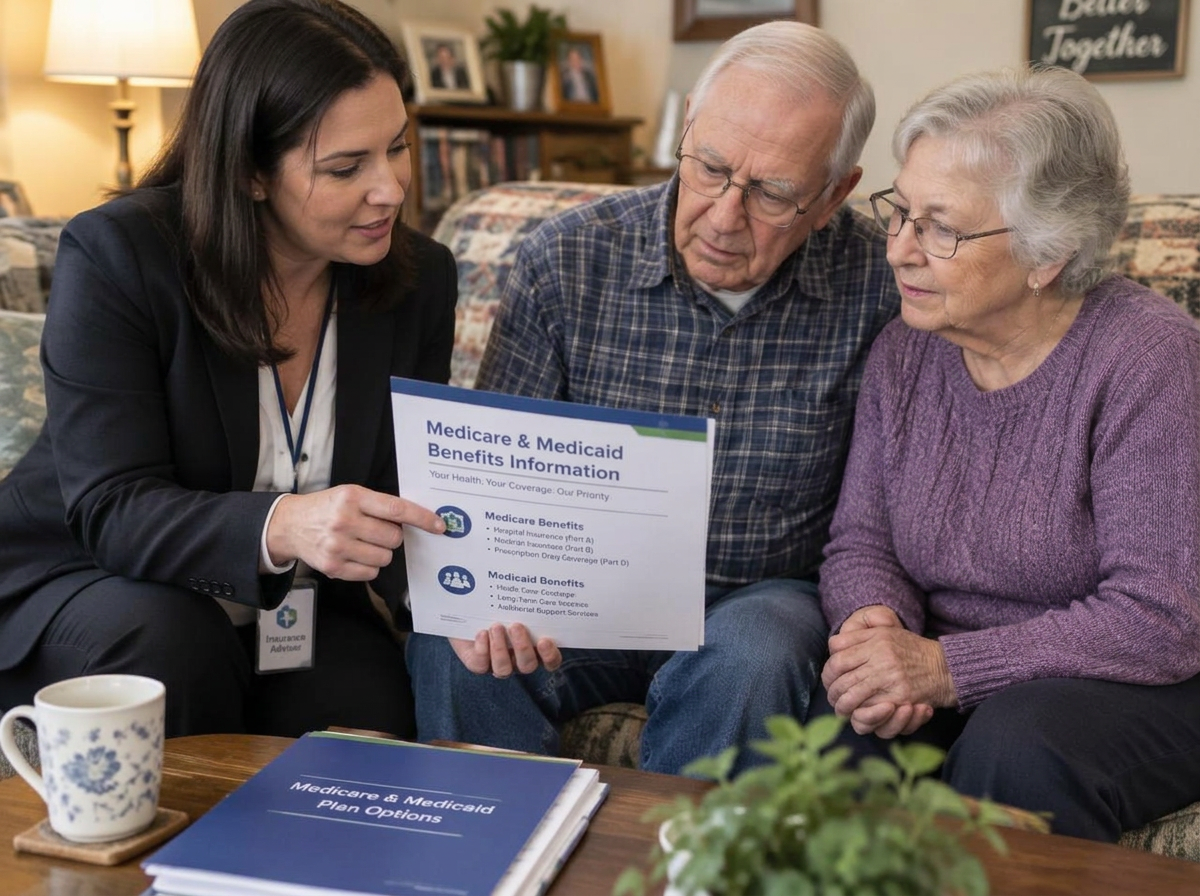

Dual-Eligible: Our Specialty
Dual-Eligible Coverage in Idaho (Medicare + Medicaid)
Dual-eligible coverage means you qualify for Medicare and Idaho Medicaid at the same time. It is the most confusing spot in the whole system. Two programs. Two sets of rules. Two cards in your wallet, and nobody whose actual job it is to make them line up. We do that work for families across Idaho, from our office in Idaho Falls. This page covers what you qualify for, what you should stop paying, and the county rule that catches people out.
What "dual eligible" means in Idaho
You are dual eligible if you have Medicare and also get help from Idaho Medicaid. That help can be full Medicaid coverage, or it can be one of the Medicare Savings Programs that pay your Medicare costs. There is no separate dual-eligible application. You apply for Medicaid or a Medicare Savings Program, and if you already have Medicare, you are dual.
Idaho's two coordinated programs, MMCP and Idaho Medicaid Plus, have a narrower test. The state describes them as being for people over 21 who are enrolled in Medicare Parts A, B and D and have Medicaid enhanced plan benefits.
What trips people up is that dual eligible is not one status. There are four main levels of it, and the level you land in decides what Medicaid actually pays. Our Idaho dual-eligible guide goes through each one in detail.
The four levels of help, and why yours matters
Here is what a single person can have in monthly income and countable resources in 2026, according to the Idaho Department of Health and Welfare.
- QMB. Up to $1,350 a month and $9,950 in resources. Medicaid pays your Part B premium plus your Medicare deductibles, coinsurance and copays.
- SLMB I. Up to $1,616 a month and $9,950 in resources. Medicaid pays your Part B premium.
- QI. Up to $1,816 a month and $9,950 in resources. Medicaid pays your Part B premium.
- Full-benefit dual. You qualify for Idaho Medicaid itself, not just help with Medicare costs. Idaho's Aid to the Aged, Blind and Disabled limit is $1,047 a month and $2,000 in resources.
For a married couple, the three Medicare Savings Program income limits are $1,824, $2,184 and $2,455, with $14,910 in resources.
Two things people get wrong. Idaho still counts assets, so a savings account or a second vehicle can matter. But your home, one vehicle, household goods and burial plots generally do not count. More detail in our breakdown of Medicare Savings Programs in Idaho.
Your two coverage choices in Idaho
Idaho runs two programs for people holding both cards, and they do different jobs.
The Medicare Medicaid Coordinated Plan, or MMCP, is voluntary. It folds your Medicare and your Medicaid into a single plan with one card, one member services number and one care coordinator, at no cost to you. Dental, non-emergency transportation and developmental disability services stay with Idaho Medicaid. Two carriers offer it in Idaho: Molina Healthcare of Idaho at 866-403-8293, and UnitedHealthcare Community Plan of Idaho at 877-370-1131.
UnitedHealthcare began offering MMCP benefits on January 1, 2026. If you compared plans before that date, you compared a shorter list than the one available now.
Idaho Medicaid Plus, or IMPlus, is the other one. It manages your Medicaid benefits only, and your Medicare coverage does not change. It is mandatory in 34 Idaho counties for people who are not enrolled in MMCP.
Which one fits depends on your doctors, your prescriptions, and whether you would rather hold one plan or two. Our MMCP breakdown runs the comparison, and what to compare when choosing a D-SNP covers the questions worth asking before you sign anything.
Why your county changes the answer
Here is the part that catches people out.
In eastern Idaho, IMPlus is mandatory in Bonneville, Bingham, Bannock, Jefferson, Madison, Fremont, Power and Clark counties. It is not mandatory in Teton, Caribou, Butte, Custer, Lemhi, Bear Lake, Franklin or Oneida counties. Across the rest of the state, most populated counties, including Ada, Canyon, Kootenai and Twin Falls, are also on the mandatory list. The full list is on the state's Medicare Medicaid Members page.
What that means in practice: if you live in Idaho Falls, Ammon, Blackfoot, Rigby, Rexburg or Pocatello and you do not choose MMCP, you go into IMPlus. The state mails a selection notice, and if you do not pick a health plan, one is picked for you.
That is not a bad outcome. Plenty of people do well on the plan they were given. But it is a decision made for you rather than by you, and most people find out when the letter arrives. If you would rather choose, choose early. You can change your IMPlus health plan once a month, so a poor fit is fixable. It is a lot easier to get it right the first time.
Choose your plan before the state chooses one for you.
What you should stop paying once you qualify
This is the section people wish they had read a year earlier.
If you have QMB, federal law prohibits Medicare providers and suppliers, including pharmacies, from billing you for Medicare cost sharing. No Part A or Part B deductibles. No coinsurance. No copays on Medicare-covered services.
Providers still send those bills. It happens constantly, it is usually an honest billing error, and the bill looks completely legitimate. If you have QMB and one shows up, do not pay it. Call the provider, tell them you are in the QMB program, and call us if it does not stop.
Extra Help is the other one worth knowing. If you have full Medicaid, a Medicare Savings Program, or SSI, you qualify for Extra Help with your Part D drug costs automatically. There is nothing to apply for. If you are not automatic, the 2026 limits are $23,940 in income and $18,090 in resources for a single person, or $32,460 and $36,100 for a couple. We cover it further in Extra Help and the low income subsidy in Idaho.
How to apply in Idaho, and what to have ready
You apply for Medicaid through Idaho Health and Welfare, not through Medicare.
- Online at idalink.idaho.gov
- By phone at 877-456-1233
- In person at a Health and Welfare field office
Have ready: proof of income for everyone in the household, recent bank statements, details of any life insurance policy with a cash value, and your Medicare card. The resource question is where most applications stall, usually because someone forgot about a small annuity or a second vehicle. Our walkthrough of how enrollment works step by step covers the sequence.
How long it takes. Federal rules give the state up to 45 days to decide most Medicaid applications, and up to 90 days when a disability decision is needed. Answering the state's verification letters quickly is the single biggest thing you can do to speed it up.
If you are already dual and just need to know which plan you are in, Health and Welfare's line for duals is 888-528-5861, or IdahoDuals@dhw.idaho.gov.
When you can change plans
The rules tightened in 2025, and a lot of the advice still published online is out of date.
The old quarterly switching window for dual eligibles ended on January 1, 2025. What replaced it is narrower.
- Once a month, you can leave a Medicare Advantage plan for Original Medicare with a standalone Part D drug plan, or switch standalone Part D plans.
- If you are a full-benefit dual, you can enroll in an integrated plan that lines up with your Medicaid managed care plan in any month.
- Separately, on the Medicaid side, you can change your IMPlus health plan once a month.
Everything else follows the normal Medicare calendar. Open Enrollment runs October 15 to December 7. The Medicare Advantage Open Enrollment Period runs January 1 to March 31. Full dates are on our enrollment periods page.
What is changing in 2027
CMS is tightening the link between a person's Medicare plan and their Medicaid plan. Starting in 2027, enrollment in certain dual-eligible Medicare plans will be limited to people who are also enrolled in the same company's Medicaid plan.
For most people this will change nothing. For anyone whose Medicare plan and Medicaid plan come from two different companies, it may.
If you enrolled through us and your plans are affected, we will contact you before open enrollment.
If you are not sure whether this affects you, call us and we will check your two plans for you.
If you are helping someone else
Most of the calls we take about dual eligibility do not come from the person on the coverage. They come from a daughter in Boise, a guardian, a facility administrator, or a discharge planner working to a deadline.
That is normal, and we are set up for it. A guardian or authorized representative can complete enrollment on someone's behalf with the right documentation in place.
If you are referring in a professional capacity, our page for professionals sets out what we need from you and what happens next. We respond to every referral within one business day.
After you enroll
Getting enrolled is the start, not the finish. Clients who enroll through us can call us for help with medical bills and prior authorizations, ordering a replacement insurance card, and calling the Department of Health and Welfare to qualify for or renew Medicaid. We also let clients know when something changes their Medicaid level.
Common questions
- What makes someone dual eligible for Medicare and Medicaid?
- You are dual eligible when you have Medicare and also qualify for some level of Medicaid help, from a Medicare Savings Program that pays your Part B premium up to full Medicaid. Medicare stays your main health coverage. Medicaid then pays some or all of your Medicare costs, and may add benefits Medicare does not cover at all.
- How do you know if you are dual eligible?
- Check whether you have an Idaho Medicaid card or a Medicare Savings Program approval letter alongside your Medicare card. If you are unsure, call Idaho Health and Welfare at 888-528-5861. They can confirm your status and which program you are enrolled in. We can also screen you over the phone in about fifteen minutes at no charge.
- Is it good to have both Medicare and Medicaid?
- Yes, in almost every case. Medicaid picks up costs Medicare leaves behind, and at the QMB level providers cannot bill you for Medicare deductibles, coinsurance or copays at all. You also get Extra Help with prescription costs automatically. The catch is that the two programs need coordinating, which is where people lose money.
- What is the difference between dual eligible and a D-SNP?
- Dual eligible describes you. A D-SNP is a type of Medicare Advantage plan built for people in that situation. Being dual eligible does not put you in a D-SNP automatically. In Idaho you choose between the Medicare Medicaid Coordinated Plan, or a separate Medicare plan alongside your IMPlus or regular Medicaid coverage.
- Does it cost anything to work with an agent on this?
- No. We are paid by the insurance carrier, not by you, and your premium is not higher for working with an agent. That holds for referrals from case managers and guardians too. We do not pay referral fees to anyone, and nobody pays us to send a client in a particular direction.
Talk to someone who does this every day
If you are sorting out coverage for yourself or for someone you look after, call us at (208) 521-3445 or book a consultation at hometownh.com/get-started. We will screen your eligibility, tell you which of the two Idaho programs fits, and handle the paperwork.
Dual-eligible cases are led by Mason Watt, who founded Hometown Health Insurance. Mason has been a licensed insurance producer since 2018 (National Producer Number and Idaho license 18776452) and has advised more than 6,000 Idahoans about their coverage. He works alongside licensed agents Jacob Madsen and Sam Cannon. If you would rather talk to someone with no connection to any insurance agency, Idaho SHIBA offers free Medicare counseling at 1-800-247-4422.
Our office is at 3729 Woodking Drive, Idaho Falls, ID 83404. We meet clients in person across eastern Idaho and help clients anywhere in the state by phone or video. During open enrollment season we also see clients on Thursdays at 360 South 4th Avenue in Pocatello. We are open Monday to Friday, 9 a.m. to 5 p.m. from September through January, and Monday to Thursday, 9 a.m. to 5 p.m. from February through August. Meetings are by appointment.